Online Reading and Spelling Resources For Foundation - Year 6
The Literacy Hub
Providing parents & carers with evidence-based literacy resources and information to support children from Foundation to Year 6 in reaching their reading and spelling potential.

The building blocks of reading
Decades of research (often called the science of reading) point to five ingredients children need to become strong, confident readers:
- Phonemic awareness -hearing and playing with the individual sounds in spoken words (that ‘cat' is /c/ /a/ /t/). This is an ear skill - it needs no letters at all.
- Phonics - matching those sounds to letters and letter patterns, so a child can decode (read) and encode (spell) words they've never seen.
- Fluency - reading accurately, at a comfortable pace, and with expression. Fluency is the bridge between sounding out words and understanding them.
- Vocabulary - knowing what words mean. A child can decode a word perfectly and still not understand the sentence if the word is new to them.
- Comprehension - the whole point of reading: making meaning, following ideas, and thinking about the text.
In the early years, most classroom time goes to phonemic awareness and phonics that is learning the reading code. As children master the code, the focus shifts to vocabulary and comprehension. That shift is why reading can feel like it ‘suddenly got harder' around Year 3.
Phonics vs phonemic awareness - what's the difference?
Parents often mix these up, but differentiating them matters. Phonemic awareness is entirely about sound - you can do it in the car with your eyes closed (‘What's the first sound in dog?'). Phonics adds the printed letters. Strong readers need both: the ear to hear the sounds, and the eye to link them to spelling.
Decodable readers vs levelled readers
Many schools now send home decodable readers, which can look ‘boring' to parents used to colourful levelled books. Here's the difference and why both have a place:
Decodable readers | Levelled readers | |
What they contain | Only the letter-sound patterns already taught, plus a few taught tricky words. | Books grouped by overall difficulty; may include patterns not yet taught. |
What they build | Accurate decoding helping a child blend sounds rather than guessing. | Broad exposure to vocabulary and sentence structure. |
Best used for | Practising a specific phonics skill until it's secure. | Read-alouds and shared reading to grow vocabulary and a love of stories. |
A word about ‘guessing' from pictures
Tip: If your child looks at the picture, sees the first letter, and guesses (‘pony' for ‘horse'), gently redirect them to look at the letters and sound the word out. Guessing from pictures or context is a habit that works on easy books and quietly fails as texts get harder. Prompt with ‘Have a go at sounding it out' rather than ‘What would make sense?'
Not sure if your child needs literacy support?
Book a free 15 minute call with Michele and have a focused conversation to discuss your child’s literacy needs and explore whether private support with Read Well Spell Well is suitable for your child.
This conversation is not an assessment or teaching session. Its purpose is to understand your child’s needs and ensure alignment before commencing private support.
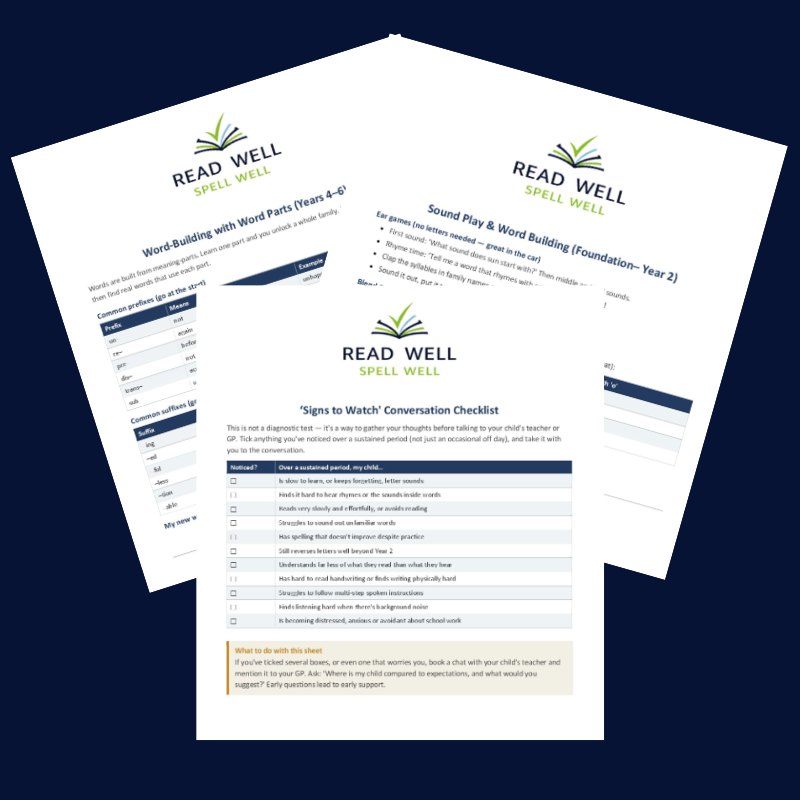
FREE WORKSHEET DOWNLOADS
Foundation, Year 1 and Year 2
These are the code-cracking years. The big job is turning sounds into letters and letters into words, then reading them accurately and often enough that they start to stick. Expect wobbles, reversals and slow going at first as it's all part of learning.
Key skills & focus areas:
Stage | Reading focus | Spelling & writing focus |
Foundation (Prep/Kindy) | Rhyme, syllables and first sounds All letter names and sounds Blend sounds to read simple CVC words (e.g. m-a-t) Begin a bank of high-frequency words | Write most letters correctly Segment simple words into sounds Spell simple CVC words phonetically |
Year 1 | Read CVC words fluently, then blends (sl, fl) and digraphs (sh, ch, th) Read one- and two-syllable words Read short decodable texts with growing confidence | Spell most one- and two-syllable words with common patterns Spell a growing bank of high-frequency words Use finger spaces and simple punctuation |
Year 2 | Read longer texts with phrasing and fluency Self-correct and re-read to keep meaning Tackle common long-vowel patterns (ai, ee, oa) | Spell many high-frequency and topic words Add common suffixes (-s, -ed, -ing) Write several linked sentences |
Tip: Every child moves at their own pace and schools vary.
Consistent forward progress matters far more than hitting an exact number by a certain date.
Phonics teaches children that letters represent sounds, and that those sounds blend to make words. Once a child knows the sounds for s, a and t, they can read (and spell) sat, they soon learn other early sounds and letters and start to read simple words they’ve never seen before. That's the power of it; phonics gives children a system rather than a list to memorise. Classrooms usually start with single consonant and short-vowel sounds, build to simple CVC words like ‘mat', then move on to blends (sl, pl, fl), digraphs (sh, ch, th), and the many ways to spell long vowels.
This is one of the most common early hurdles, and it's usually a blending problem rather than a knowledge problem. The child can say /l/ /o/ /g/ but can't hold the sounds together to hear ‘log'. Try ‘continuous blending': stretch the sounds together without stopping (llllooog) rather than saying them as separate beeps. Start with just two sounds (‘at', ‘it'), use words that begin with stretchy sounds (m, s, f, l, n), and model it first, then do it together, then let them try. It clicks for most children with short, regular practice.
Some unevenness is normal, but raise it with the teacher if, after a good stretch of instruction (like 6 months or 2 terms), your child still struggles to learn letter sounds, can't hear rhymes or first sounds, makes very little progress in blending, or is becoming distressed or avoidant about reading. Trust your instincts and ask the question ‘Where is my child compared to where they should be, and what would you suggest?' This costs nothing and often brings quick reassurance or quick help. Early support is far easier than catching up later.
Yes for practising reading. Decodable books deliberately use only the sound-spelling patterns your child has been taught, so they can succeed by sounding words out instead of guessing. They build accuracy and confidence. Keep the exciting, colourful books for you to read aloud to your child; that's where vocabulary and love of stories grow. You need both, doing different jobs.
Schools often expect Foundation children to read and write somewhere around 50–100 high-frequency words by year's end, building steadily through Years 1 and 2, but there's a wide normal range, and the exact number matters less than steady growth. Most Australian schools use the Oxford Wordlist or Magic 100 Words; the Oxford list is popular because it was built from Australian children's own writing. Ask which list your school uses so you can practise the right words. And note that many ‘sight words' are decodable. Teach the parts children can sound out rather than treating every word as pure memory.
Almost always, yes. Letter reversals are a normal part of learning to write and are common up to around age seven or eight, while children are still developing directionality. On their own they are not a sign of dyslexia. Keep an eye on it if reversals persist strongly past Year 2, especially alongside other signs like trouble rhyming, sounding out words, or remembering letter sounds. If this persists, mention it to the teacher. A simple memory aid used by many teachers is the word ‘bed'- a ‘b’ at the start, ‘d’ at the end, drawn like a little bed.
No as that turns reading into a test and drains the joy out of it. If a mistake changes the meaning, pause and help; point to the word and say ‘Have a go at sounding that out.' If it doesn't change the meaning (‘a' for ‘the'), often it's fine to let it go, or just re-read the sentence together at the end. Give them a few seconds to self-correct before you jump in. Remember, noticing and fixing their own errors is exactly the skill you want to grow.
Little and often wins like five to ten minutes of your child reading to you, most days, plus a bedtime story you read to them. For books they read themselves, use the ‘five-finger' check. If there are more than about five words on a page they can't read and the book is too hard for solo reading then choose to read together. Follow their interests; a child who loves trucks or dinosaurs will push through more text than one handed a ‘nice' book they didn't choose.
Quick Literacy Tips: Foundation - Year 2
- Play sound games with no letters: ‘What's the first sound in sun?', clap the syllables in names, think of rhymes.
- Practise blending by stretching sounds together (mmmaaan) rather than saying them as separate beeps.
- Read the decodable book for practice; read a richer story aloud for pleasure and vocabulary.
- Point out letters and words in activities of daily living like signs, cereal boxes, shop names.
- Keep it short, warm and daily. Stop before frustration and always end on a win.
- Let them see you enjoy reading. Reluctant readers often relax when the pressure lifts.
Not sure if your child needs literacy support?
Book a free 15 minute focused conversation with Michele to discuss your child’s literacy needs, and explore whether private support with Read Well Spell Well is suitable for your child.
This conversation is not an assessment or teaching session. Its purpose is to understand your child’s needs and ensure alignment before commencing private support.
Years 3 and 4
Around Year 3 the goal quietly shifts from ‘learning to read' to ‘reading to learn'. Texts get longer, vocabulary gets richer, and children are expected to understand and remember what they read, not just decode it. Spelling moves from simple patterns to word families, and the reasons behind spelling.
Key skills & focus areas:
Area | What to expect in Years 3–4 |
Reading fluency | Read longer texts smoothly, at a comfortable pace, with expression Fluency should be automatic enough to free up attention for meaning. |
Comprehension | Find information, make simple inferences, retell and summarise. Discuss characters, cause and effect, and the author's purpose. |
Vocabulary | Learn many new subject words (science, history, maths) called Tier 3 words. Work out unknown words from context and word parts. |
Spelling | Spell many common and topic words reliably. Use word families and common prefixes/suffixes. Begin to understand why words are spelled the way they are. |
Writing | Write organised paragraphs with correct spelling of familiar words. Proofread and correct their own spelling. |
This is extremely common and it can happen even to children who read aloud beautifully. Decoding and comprehension are different skills. Sometimes the words are decoded but their meanings aren't known; sometimes the child is reading so word-by-word that the sentence never comes together as a whole idea. Build comprehension by talking about text like ask what's happening, what might happen next, and what in the story makes you think that? Grow vocabulary by explaining new words as you meet them. And keep reading richer books aloud. Note that hearing fluent, expressive reading teaches how ideas connect.
Because the curriculum changes. In the early years, most of the work is decoding, and texts are short and heavily supported by pictures. From Year 3, children are expected to read longer passages independently and understand, infer and remember text with less picture support and far more unfamiliar vocabulary. A child who was ‘fine' can hit this wall not because they've gone backwards, but because the demands jumped. The fix is usually vocabulary and comprehension practice, plus making sure fluency is genuinely automatic.
Rote copying of a weekly list rarely sticks, because English can't simply be ‘sounded out'. The same sound has many spellings. What works better is teaching patterns and word parts rather than isolated words: word families (light, night, fright), common prefixes and suffixes, and a few reliable rules. Use ‘test–study–test' so effort goes only to the words your child actually gets wrong. Keep sessions short and spaced across the week rather than crammed the night before, and make it multisensory (say it, build it with letter tiles, write it, check it). If spelling stays stubbornly resistant despite good teaching, mention it to the teacher.
A morpheme is the smallest unit of meaning in a word. ‘Unhappiness' is three: un- (not), happy, and -ness (a state of being). Teaching children to see these parts is one of the most powerful spelling and vocabulary tools there is, because meaning-parts stay spelled consistently even when the sound changes (the ‘sign' in ‘signal', the ‘magic' in ‘magician'). Once a child knows a base word, they can read, spell and understand a whole family of words at once. This becomes a major focus in the upper primary years, but it's well worth starting now.
Fluency grows through re-reading and modelling. Try echo reading (you read a sentence with good expression, then your child reads the same sentence back), choral reading (read the same text out loud together), and simply re-reading a favourite passage a few times until it flows. Poems, jokes, and readers-theatre scripts are great because re-reading feels natural. Keep the texts at a comfortable level as fluency practice should feel easy, not like a struggle.
They can be, if they're used well. A test that simply ranks children and moves on doesn't teach much. But the ‘test–study–test' cycle, a quick pre-test to find the tricky words, focused study on just those, then a re-test is genuinely effective. This targets effort where it's needed and spaces practice out. If your child aces the Friday test but can't spell the same words in their own writing a fortnight later, that's a sign the words were memorised for the test, not truly learned and a signal to teach the underlying pattern instead.
First, take the pressure off as children can sense our worry, and it makes reading feel like a chore. Let them choose their own material, even if it's comics, joke books, footy magazines or the same book for the tenth time. Try ‘high-interest, easy-reading' (hi-lo) books that feel grown-up but read easily. Keep reading aloud to them (yes, even now) and use audiobooks alongside the print. Celebrate small wins like a paragraph, a page, a chapter rather than measuring. Reluctance is very often a mismatch between the book and the child, not a problem with the child.
Quick Literacy Tips: Year 3 and Year 4
- Talk about books- before (what might this be about?), during (what's happening?), after (what was the best/worst part, and why?).
- Always ask ‘what in the text makes you think that?' This teaches children to find evidence.
- Explain new words as you meet them, and notice word parts (un-, re-, -ing, -tion).
- Build spelling from patterns and word families, not random lists. Study little and often.
- Re-read for fluency like poems, scripts and jokes make it fun.
- Let them choose what they read. Interest beats ‘level' for motivation.
Not sure if your child needs literacy support?
Book a free 15 minute focused conversation with Michele to discuss your child’s literacy needs, and explore whether private support with Read Well Spell Well is suitable for your child.
This conversation is not an assessment or teaching session. Its purpose is to understand your child’s needs and ensure alignment before commencing private support.
Years 5 and 6
These are the consolidation years before high school. Children read to learn across every subject, handle abstract and figurative language, and are expected to infer, evaluate and justify. Spelling becomes about word origins and meaning-parts, which also powers vocabulary for the years ahead.
Key skills & focus areas:
Area | What to expect in Years 5–6 |
Comprehension | Identify main ideas and themes; make and justify inferences. Explain characters' motivations and the author's purpose. Use evidence from the text to support answers, in full sentences. |
Vocabulary | Work out word meanings from context, roots and affixes. Handle subject-specific and abstract vocabulary. Understand figurative language like metaphor, idiom, symbolism. |
Spelling | Use base words, prefixes, suffixes and word origins to spell new words. Read and spell words that share letter patterns but sound different. Explore less common plurals and spelling generalisations. |
Writing | Plan, draft and edit longer pieces across genres. Spell most words correctly and self-correct the rest. |
Reading persistence and variety | Sustain attention across chapters and longer non-fiction. Read widely, including print and digital texts. |
Inference is ‘reading between the lines' like working out what the text implies but doesn't say outright. For example, if a character slams a door and won't speak, we infer they're upset. It's the comprehension skill upper-primary children most need and the one NAPLAN-style questions lean on hardest. Teach it through everyday conversation about texts, films and even people: ‘How do you think she's feeling? What makes you say that?' Always push for the evidence. The same ‘what in the text tells you that?' habit you used in earlier years now does heavier lifting.
Keep it low-key and skills-focused rather than test-focused. By Year 6 children are expected to find the main idea, make inferences, understand vocabulary in context, and justify answers with evidence from the text. Practise those skills through normal reading, not drills. After a chapter, ask ‘what's the main idea here?' or ‘why did the author include this bit?' If you do use practice papers, treat wrong answers as interesting (‘let's find the part of the text that gives the answer') rather than as failures. Confidence and a calm approach matter as much as content.
The short answer is ‘no’ and persistent spelling difficulty at this age is worth taking seriously rather than accepting as ‘just how they are'. At this stage the most effective approach is word study built on morphology: teaching the base words, prefixes, suffixes and word origins that explain why words are spelled as they are, so your child spells by understanding rather than memory.
Occasionally, yes as it's a quick, revealing check. If your Year 5–6 child reads aloud haltingly, ignores punctuation, or reads in a flat monotone, fluency may not be as automatic as it looks, and that can quietly cap comprehension. You don't need daily read-alouds now, but sharing a page, a news article or a recipe from time to time lets you hear how they're going and keeps reading a shared, positive thing rather than a solo chore.
Vocabulary at this age increasingly comes from reading and from meaning-parts. Keep exposing your child to rich texts like quality fiction, non-fiction, and read-alouds slightly above their own reading level. When you meet a new word, don't just define it but connect it to words your child already knows and point out the parts (‘transport, transfer, translate — trans means across'). Knowing common Greek and Latin roots unlocks huge families of subject words in science and the humanities. Talking with your child about ideas, using precise words yourself, matters more than any worksheet.
Stamina grows the way fitness does — gradually and with buy-in. Find a series or topic they genuinely love and let momentum build across books. Set a gentle daily reading time (even 15 minutes moves the needle enormously over a year) and protect it from screens. Audiobooks paired with the print text are a legitimate bridge, not cheating as they build vocabulary and stamina while easing the decoding load. Model it; a household where adults read tends to produce children who read.
Quick Literacy Tips: Year 5 and Year 6
- Practise inference in conversation: ‘How do you know? What in the text tells you?'
- Teach spelling and vocabulary through base words and affixes (trans-, -tion, bio-, -graph).
- Read widely and slightly above level via read-alouds and audiobooks.
- Protect a daily reading time; let a beloved series build stamina.
- Keep NAPLAN practice calm and skills based. Treat wrong answers as clues, not failures.
- Talk about ideas using precise words. Your everyday vocabulary teaches theirs.
Not sure if your child needs literacy support?
Book a free 15 minute focused conversation with Michele to discuss your child’s literacy needs, and explore whether private support with Read Well Spell Well is suitable for your child.
This conversation is not an assessment or teaching session. Its purpose is to understand your child’s needs and ensure alignment before commencing private support.
Articles
Page [tcb_pagination_current_page] of [tcb_pagination_total_pages]
Useful links:
Free Download:
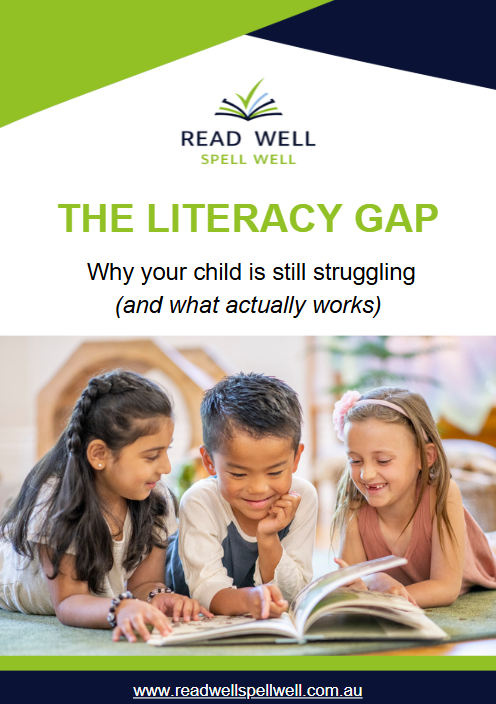
Make life easier and take the guesswork out of finding the right literacy support for your child's learning needs.
**Please note we will also send your our regular Read Well Spell Well tips and tools for you to support your child with reading and spelling. You are free to unsubscribe at any time.
Read Well Spell Well acknowledges the Traditional Custodians of Country throughout Australia and their connections to land, sea and community. We pay our respects to Elders past and present, and extends our respects to all Aboriginal and Torres Strait Islander people.
2026 All rights reserved - Read Well Spell Well